
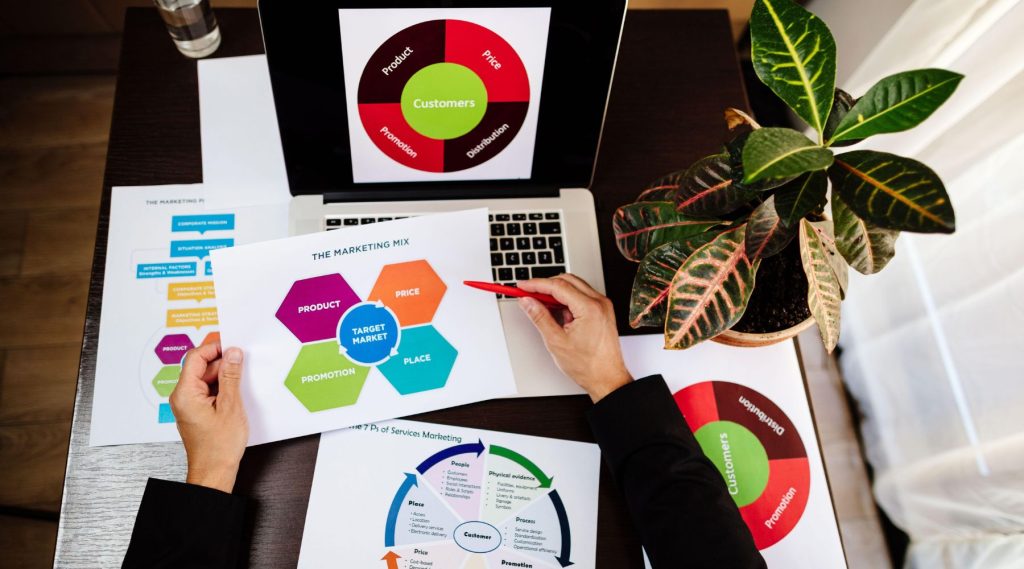
The 7 Ps of marketing add People, Process and Physical Evidence to the classic four (Product, Price, Place, Promotion). Service businesses need these extra three because customers can’t see, touch or test a service before they buy it, so they judge you by the people they deal with, how smooth the experience is, and the visible proof that you do good work. Online, that proof is mostly your website, reviews and photos; the process is your booking and follow-up.
Here’s what each of the three added Ps means, why it matters for services, and how to strengthen it in practice.
Why the Original 4 Ps Weren’t Enough for Services
The 4 Ps were designed around physical products. You can examine a lawn mower in a store before buying it. You can’t examine a lawn care service until it’s already been performed on your lawn. Services are intangible, produced and consumed at the same time, and vary depending on who delivers them.
In the early 1980s, marketing researchers Bernard Booms and Mary Jo Bitner proposed extending the mix with three more Ps to account for that. If you need a refresher on the original four first, our guide to the 4 Ps of marketing with service examples covers each one.
People: Everyone the Customer Interacts With
In a service business, your people are part of the product. The receptionist who answers the phone, the technician who shows up, the account manager who sends updates: each one shapes whether the customer feels confident and comes back.
What this includes:
- Hiring for attitude and communication, not just technical skill.
- Training on how to explain work, handle complaints and set expectations.
- Appearance and professionalism: uniforms, vehicles, punctuality.
- Empowering staff to fix small problems on the spot.
Example: Two veterinary clinics have equally skilled doctors. At one, front-desk staff remember pets’ names and call the next day to check on recovery. Customers describe that clinic as “caring,” and that word ends up in their reviews.
Online angle: Show your people. A team page with real photos and short bios, technician names in appointment confirmations and staff mentioned in reviews all reduce the uncertainty of letting a stranger into your home or business.
Process: How the Service Is Delivered
Process is the sequence of steps a customer goes through, from first contact to finished job and beyond. A good process feels easy and predictable. A bad one feels like chasing someone for answers.
Map your customer’s process from their side:
- Discovery: finding you on Google, a referral or an ad.
- Contact: calling, filling in a form or booking online.
- Response: how quickly and clearly you reply.
- Quote or consultation: clarity of the estimate and next steps.
- Scheduling: confirmation, reminders, arrival windows.
- Delivery: the work itself and communication during it.
- Follow-up: invoice, satisfaction check, review request, maintenance reminders.
Example: A mobile auto detailer adds online booking with real-time availability, an automated reminder the day before and a text when the detailer is 30 minutes away. Nothing about the actual detailing changed, but customers perceive a more professional business.
Online angle: Much of the process now lives on your website and in your tools: booking forms, instant confirmation emails, reminder texts, and post-service follow-ups. Explaining your process on service pages (“Here’s what happens after you call”) also lowers hesitation for first-time customers.
Physical Evidence: Proof the Customer Can See
Since a service can’t be inspected beforehand, customers look for tangible clues about quality. Traditionally, that meant a clean office, branded vehicles, professional uniforms and printed materials. Those still matter, but today most physical evidence is encountered online first.
| Traditional evidence | Online equivalent |
|---|---|
| Clean, well-designed office | A fast, professional, easy-to-use website |
| Word-of-mouth recommendations | Google reviews and testimonials |
| Portfolio binder | Project galleries, before-and-after photos |
| Certificates on the wall | Licenses, certifications and memberships listed on your site |
| Branded trucks and uniforms | Consistent branding across website, Google Business Profile and social |
| Printed brochure | Detailed service pages and FAQs |
Example: A kitchen remodeler competes with three others for a project. The homeowner checks all four websites. One has a gallery of finished kitchens with project descriptions, recent reviews mentioning specific crew members and a clear explanation of the remodeling process. That site does the selling before the first call.
Reviews deserve special attention because they function as both physical evidence and social proof. How you collect, respond to and showcase them affects what people see when they search your business name, which we cover in our guide to owning your branded search results through reputation management.
How the Three Added Ps Connect
People, process and physical evidence reinforce each other. Good people make the process smooth. A smooth process produces happy customers. Happy customers leave reviews and allow photos, which become physical evidence. That evidence attracts new customers, and the cycle repeats.
Break one link and the cycle weakens. A great technician who never asks for a review leaves no evidence behind. An excellent website promising easy booking falls flat if nobody answers the phone.
A Quick 7 Ps Self-Audit for the New Three
- People: Would you be comfortable if a prospective customer read every review mentioning your staff by name?
- Process: How long does it take to respond to a new inquiry? Is there a confirmation and reminder for every appointment? Does anyone follow up after the job?
- Physical evidence: Does your website show real work, real people and recent reviews? Would a stranger trust it within ten seconds on a phone?
Frequently Asked Questions
Do product businesses need the 7 Ps too?
They can benefit, especially if they include service elements like installation, support or delivery. But the extra three Ps are most important for businesses where the service itself is the thing being sold.
Which of the three added Ps should I improve first?
Start with physical evidence online if your website and reviews are thin, because that’s what prospects judge before ever contacting you. If prospects are reaching out but not booking, look at process: response time, quote clarity and follow-up.
Is the website really “physical evidence”?
Functionally, yes. It’s the tangible thing customers can examine before deciding whether to trust you. A dated or broken website creates the same doubt a messy office would.
Your Website Is the Evidence Room
For service businesses, the website is where people, process and physical evidence come together in one place: team photos, booking tools, galleries, reviews and clear explanations of how you work. If your site doesn’t yet show prospects the quality your customers already experience, our website design services can build it around those proof points.