
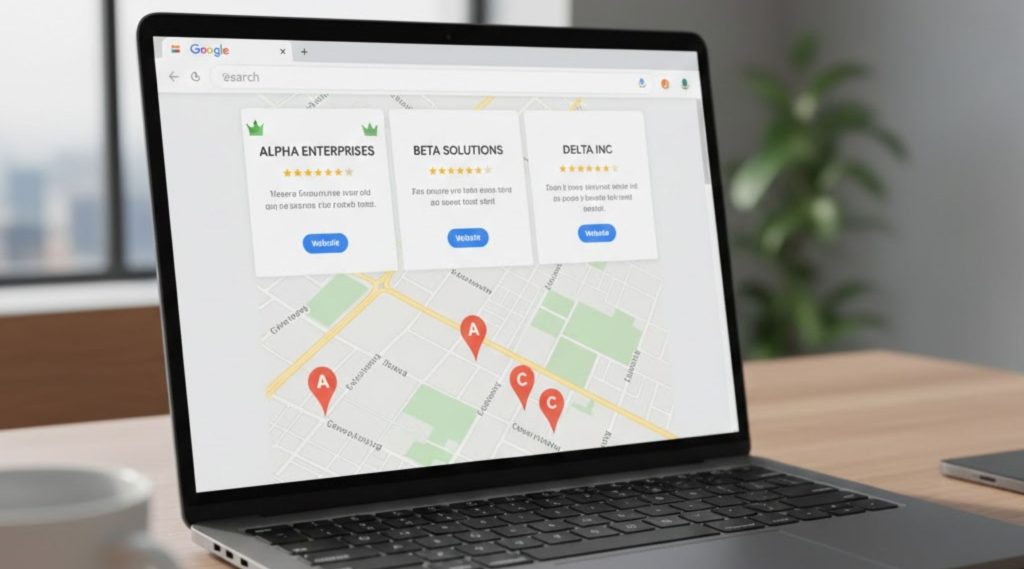
To rank in Google’s Maps 3-Pack, you need Google to see your business as the most relevant, closest and most prominent answer for a search. Google itself names those three factors: relevance, distance and prominence. You fully control relevance, you partly control prominence, and you barely control distance, so the smart play is to max out the first two and widen your reach honestly where the third holds you back.
This post explains how to rank in Google Maps by breaking down each pillar. It shows which levers are actually in your hands and explains why no amount of optimization will make a shop show up in the 3-Pack forty miles away.
What the 3-Pack Is and Why It Gets the Calls
The 3-Pack is the block of three business listings with a map that appears for searches with local intent, like “emergency electrician” or “dog groomer near me.” It often sits above the regular organic results, and each listing has buttons for calling, getting directions and visiting the website.
That layout matters because a searcher can contact you without ever scrolling. For businesses that sell to people nearby, the 3-Pack is frequently where the first phone call comes from. The same listings also feed Google Maps itself, so improving one usually improves the other.
Pillar 1: Relevance (the Lever You Control Most)
Relevance is how well your profile and website match what the person searched. Google reads your Business Profile, your website and mentions of you around the web to figure out what you do.
Your primary category
The primary category on your Google Business Profile is one of the strongest relevance signals you have. A business listed as “Family Law Attorney” competes differently from one listed as “Lawyer.” We cover how to choose it, plus secondary categories and services, in our guide to Business Profile categories and services.
Your website’s service pages
Your profile links to your website, and Google uses that page to confirm what you offer. A heating and cooling company with a single generic homepage gives Google less to work with than one that has dedicated pages for furnace repair, AC installation and duct cleaning. Each page should clearly name the service, the area served and what makes the work trustworthy.
Consistent business details
Your name, address and phone number should match across your website, your profile and the major directories. Mismatched details create doubt about which listing is correct. Our post on which local citations still matter explains where to focus that cleanup.
Pillar 2: Distance (the Lever You Barely Control)
Distance is how far your business is from the searcher, or from the location named in the search. If someone in north Phoenix searches “tire shop,” Google favors shops close to them. If they search “tire shop in Mesa,” Google uses Mesa as the reference point.
This is the factor that frustrates owners most, and it helps to accept it early:
- You can’t move your verified address without actually moving.
- Expanding your service area settings does not make you rank farther away. Those settings tell customers where you travel; they are not a ranking dial.
- Rankings change block by block. You may be first for a search made near your office and absent two cities over. That is normal, not a penalty.
Some businesses try to fake proximity with virtual offices or mailbox addresses in other cities. That violates Google’s guidelines and is one of the most common reasons profiles get suspended. If you’re dealing with that kind of problem, see how to fix verification issues, suspensions and duplicate listings.
Pillar 3: Prominence (the Lever You Build Over Time)
Prominence is how well known and trusted your business appears to be. Google describes it as drawing on information from across the web, including links, articles, directories and reviews. Some places are prominent offline too, and Google tries to reflect that.
Reviews
Review count, rating, recency and the content of reviews all feed prominence. A steady stream of genuine reviews tells Google the business is active and that customers keep choosing it. Replies from the owner show the profile is managed.
Website authority
Your website’s general organic strength carries into local results. Links from local organizations, suppliers, sponsorships and local news coverage help your site look established. A strong website is part of why some businesses rank in the 3-Pack even when they aren’t the closest option.
Mentions and citations
Being listed accurately on data aggregators, Apple Business Connect, Bing Places and the directories specific to your industry gives Google more corroboration that you exist where you say you do.
Which Levers Should You Pull First?
If you only have a few hours a month, work in this order:
- Fix the profile basics. Correct primary category, accurate hours, a real phone number and a link to the most relevant page on your site.
- Strengthen the linked page. Make sure the page your profile points to clearly describes your main service and service area, loads fast on a phone and makes calling easy.
- Build a review habit. Ask every satisfied customer, every week, rather than running a one-time push.
- Clean up citations. Find and correct old addresses, former phone numbers and duplicate listings.
- Earn local links. Sponsorships, partner pages and community involvement that would make sense even if Google didn’t exist.
How to Widen Your Reach Honestly
Because distance limits where your listing appears, the honest way to reach customers farther out is through your website rather than your profile.
- Location pages with real substance. A landscaper based in Gilbert who regularly works in Chandler and Queen Creek can publish pages for those areas that describe actual projects, local conditions and the services offered there. Thin pages that swap city names into the same paragraph do not help.
- Local organic results. Below the 3-Pack, regular organic listings are less tied to distance. A strong location page can rank there even when your map listing doesn’t appear.
- Paid options for distant areas. If a far-off city matters to your revenue, Google Ads or Local Services Ads can put you in front of those searchers while organic visibility grows.
- A second location, only if real. If you genuinely open a staffed office in another city, it can have its own profile. A rented mailbox doesn’t qualify.
How to Check Where You Actually Rank
Searching from your own phone at the office will mislead you, because your results are centered on where you’re standing. Instead, check your profile’s Performance section for the searches that triggered your listing, the calls and the direction requests. Grid-based rank tracking tools can also show how your position changes across a map of your area, which makes the distance effect easy to see.
Track changes over months, not days. Local rankings move with competitor activity, new reviews and Google updates, so single-day snapshots tell you very little.
Frequently Asked Questions
Can I rank in the 3-Pack for a city where I don’t have an office?
It’s difficult, because distance is a core factor. Businesses sometimes appear in nearby cities when competition there is thin and their prominence is strong. For dependable visibility in distant areas, rely on location pages on your website and paid ads instead.
Does adding keywords to my business name help?
It can produce a short-term bump, but it violates Google’s guidelines, and competitors can report it. Profiles with keyword-stuffed names risk suspension, which wipes out all visibility. Use your real-world business name.
How long does it take to get into the 3-Pack?
It depends on competition, your starting point and how many factors need work. Fixing a wrong category can have an effect fairly quickly, while building reviews and links takes steady effort over many months.
Where Your Website Fits Into Map Rankings
The 3-Pack looks like a Google Business Profile game, but your website does a lot of the work behind it: it confirms relevance, carries authority and catches the visitors your listing sends. If your listing shows up and your site loads slowly or reads vaguely, you lose the lead anyway. Our local SEO services cover the profile, the service pages and the authority building together, so the three pillars support each other instead of being handled one at a time.